TLDR: if you use Gmail as your email client we recommend moving your domain emails to Zoho. [Jargon: Email Client means the program where you view and send emails].
Google is removing support for collecting external (domain) email via POP (Post Office Protocol) into personal Gmail accounts. (See below for more info about POP). Existing setups will stop working in January 2027.
Many small businesses have relied on this to access their website domain email without having to pay for professional email services. [Jargon: domain email means your business email address, like hello@webzang.co.uk].
This change from Google will force Gmail users to change how they access their domain emails and they will be forced to use a different email client instead. This is probably because Gmail wants to a) get away from outdated message delivery systems, and b) encourage business users to sign up to their paid email client that comes as part of Google Workspace.
What POP Is and How It Works
POP (usually POP3) is a one-way collection system. It allows you to receive and send emails using your domain email address, all within your Gmail inbox.
How it operates
- An email arrives at your hosting server mailbox (e.g.
info@yourdomain.co.uk). - Gmail logs in periodically and downloads a copy and you see it in your inbox.
- Gmail stores the email in Google’s servers.
- The email is deleted from the hosting server.
Where POP emails are stored
| Location | Storage impact |
|---|---|
| Web hosting server | Minimal (emails deleted after collection) |
| Gmail account | Within Gmail itself (15GB available) |
Why POP was popular
- Very low hosting storage usage
- Cheap shared hosting works fine
- Users stay inside Gmail interface
- No need for a full mail platform
Limitations
- No true synchronisation/backup
- Sent mail not synced to server
- up to 1 hour delay in mail arriving to inbox
- Multiple devices unreliable
- Reply identity can break
- Increasingly deprecated
POP is fundamentally a legacy system designed for a single computer era. Many providers (such as Hotmail) have already withdrawn support for POP access some years ago.
What is IMAP and How It Works
IMAP (Internet Message Access Protocol) is a synchronised mailbox system. It also allows you to receive and send emails using your domain email address, all within various dedicated email clients such as Mac Mail, or Outlook. Unfortunately, Gmail does not support IMAP either.
How it operates
- Email arrives on the mail server (e.g.
info@yourdomain.co.uk). - Every device connects live to the same mailbox
- Actions sync in real time (read, delete, folders, sent mail) across all devices.
Where emails are stored
| Location | Storage impact |
|---|---|
| Dedicated Email server | Full mailbox is stored permanently |
| Connected apps (Phone mail app, Mac mail, Outlook, Zoho, etc.) | View only — not primary storage - emails sync between your device and your main storage. |
Benefits
- True multi-device sync
- Sent mail stored correctly
- instant access to email inbox
- Folder organisation preserved
- Industry standard going forward
- Required by modern providers
Hosting impact
IMAP requires large permanent storage for every mailbox.
Shared website hosting is designed primarily for websites, not for acting as a full mail server for many users. Supporting IMAP at scale dramatically increases disk usage, backups, and server load.
Why POP Support Is Being Withdrawn from my hosting service
Because Gmail is removing the ability to collect mail from external servers via POP, it is no longer viable to continue offering POP-based email workflows on shared hosting.
Historically:
- POP = minimal hosting resources
- IMAP = heavy hosting resources
Providing IMAP mailboxes for all clients would require enterprise mail infrastructure rather than web hosting.
Therefore, POP collection must be retired, and email must move to a dedicated mail platform.
Your Options Going Forward
If you are hosting with Webzang and you currently access your domain email inside Gmail via POP, you will need to choose one of the following:
Option 1 — Quick and easy: minimal effort: Convert to Email Forwarding
Email is forwarded to your Gmail account instead of being collected.
How it works
- Mail sent to
you@domain.co.ukautomatically forwards to Gmail - Gmail stores the message
- A separate copy of the message exists on your server Mailbox and will need to be periodically cleared out/deleted.
- You can still SEND AS the domain email so it works in almost an identical way.
- Works for very low volumes of emails with no attachments.
Implications
- Your hosting server mailbox will reach capacity very quickly, especially if you have lots of emails and send/receive attachments.
- If you don't delete the emails from the server inbox when you get an alert, new incoming emails will bounce and you won't necessarily know.
- Reaching hosting capacity because your email inbox is full can also have an impact on your website and slow it down or cause it to crash.
Best for: small businesses with a single email and relatively low email traffic.
Read our guide on how to get this set up.
Option 2 — Low cost, easy and versatile: Move to Zoho Mail (Recommended)
A dedicated mail provider replaces hosting email entirely.
Zoho Mail Lite plan:
- Very low cost - 80p per month per user (less than £10 per year per mailbox)
- 5GB mailbox per user
- Proper IMAP support with Mac Mail & Outlook
- Reliable deliverability
- has a dedicated mail app so you can keep work and personal emails separate.
BUT Zoho does not work with Gmail so you will need to use a separate email client for your domain emails (such as Outlook, Mac Mail, or Zoho's dedicated email app)
Benefits
- Future-proof
- Full sync across devices
- Professional sending reputation
- Minimal ongoing maintenance
- Massive mailbox
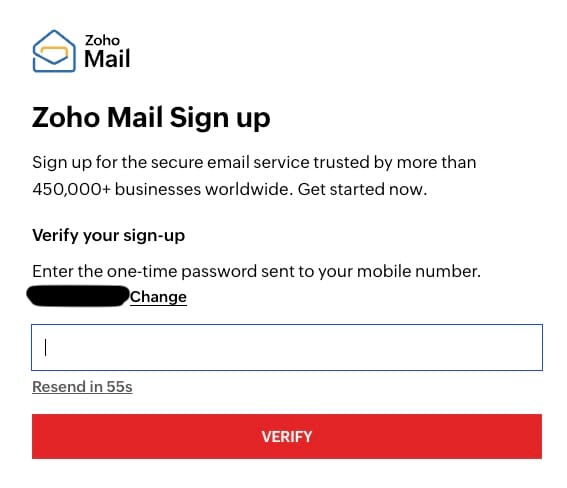
We offer a standard £35 set-up fee for our existing hosting clients. You need to create a Zoho Account first, and purchase the mailbox plan, and we can do the rest. See our guide on how to get set up with Zoho Email here.
Option 3 — Medium cost but most professional: Use Google Workspace
Premium business email platforms. We recommend Google Workspace, which is £5 per month per mailbox but also gives access to Drive and other Google Services and doubles the mailbox capacity to personal Gmail.
Advantages
- Enterprise reliability
- Advanced spam filtering
- Full integration ecosystems
- can easily migrate domain emails from personal Gmail into the new account
Considerations
- Higher monthly cost
- Overkill for many small sites
- Does not work with personal Gmail and requires you to have a separate email client to your personal emails.
Best for - businesses with multiple emails and a desire to separate work from personal emails and storage.
Option 4 — Move to Another POP Provider (Temporary Only) - not recommended
Some external mail providers still allow POP collection.
Examples include smaller legacy mail hosts.
However:
- Major providers are eliminating POP
- Microsoft/Hotmail already withdrawn similar functionality
- This solution will fail eventually
Conclusion: This only delays migration. Moving to IMAP once now avoids repeating the process later.
Website Changes After Moving Email
If your website sends email (contact forms, ecommerce receipts, memberships):
SMTP settings must be updated if you change your email provider.
Affected features:
- Contact forms
- WooCommerce order emails
- Membership notifications
- Booking systems
- Password resets
Without updating SMTP:
Emails may fail or go to spam.
FAQ
What happens if I do nothing?
Mail will stop arriving in Gmail. Messages will remain on the server until the mailbox fills, after which senders receive delivery failures. Gmail will likely have a pop-up notification that POP services have been withdrawn - at present, they have announced that existing setups will stop working in january 2027. They have already stopped new POP accounts from being created.
Will I lose old emails?
No — Gmail keeps already downloaded POP mail. Only future mail is affected.
Can I still use Gmail to read mail?
Yes — but only if you go with the email forwarded option.
Why can’t hosting just provide IMAP?
Shared web hosting is sized for websites, not full mail servers. Permanent synced mailboxes across many users exceed disk, backup, and performance limits.
Is forwarding good enough?
Yes if you have quite low-volume email traffic and you are really keen to have a combined inbox. It is possible that in future, Gmail also withdraws support to SEND MAIL AS functionality, but for now, it works.
Why is POP disappearing everywhere?
Modern email requires multi-device sync, security auditing, and a reliable sending identity. POP cannot support these.
Recommendation
Move to a dedicated IMAP mail provider (preferably Zoho Mail Lite) and update the website SMTP once.
This aligns with industry direction and avoids repeated migrations as legacy systems are removed.
Separate your work and personal emails and this will also help your mental health and to create good work-life boundaries.
Feel free to get in touch if all of this is confusing as hell and we can talk you through your options. Just email hello@webzang.co.uk