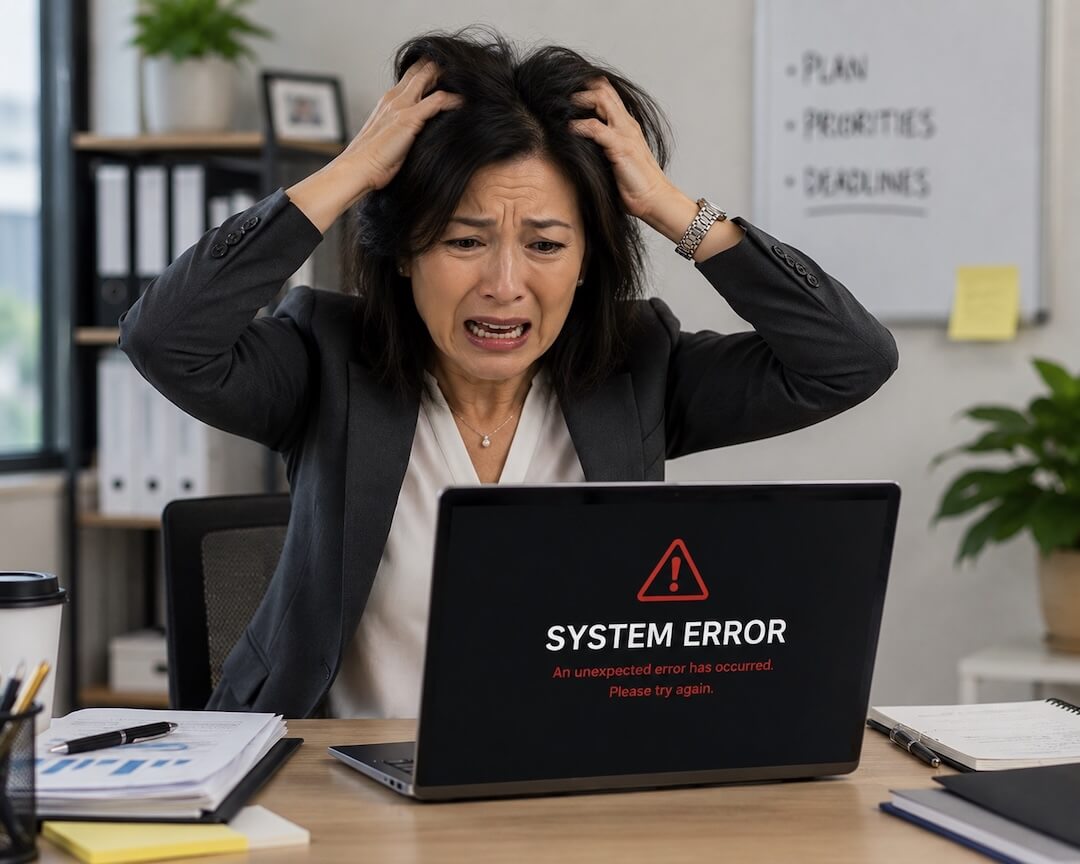
You update a plugin. The screen goes white. Your website has vanished.
Or maybe you haven't touched anything at all — and it's still broken. A page that used to work just… doesn't. The checkout isn't taking payments. Something looks wrong but you can't put your finger on what. You log a support ticket with your developer and either hear nothing back, or get a reply so full of jargon you feel more confused than before.
Sound familiar?
If you've been running a WordPress website for more than three or four years and it's starting to feel like a liability rather than an asset, you are not alone — and more importantly, you haven't done anything wrong.
The problem isn't you. It's the age of the website.
WordPress websites are made up of layers. There's the theme (the design and layout), the plugins (the bits that do specific jobs, like contact forms, booking systems, or online shops), and underneath it all, WordPress itself, which updates regularly.
When a website is built well, these layers work together. When a website is built cheaply, or hasn't been properly maintained, they start to fight each other.
Here's what typically goes wrong on an older site:
The theme has been hard-coded.
Some developers build websites by writing everything directly into the theme files — custom code that makes the site look exactly right for that moment in time. The problem is that when WordPress updates (which it does constantly, for good security reasons), that hard-coded theme can't keep up. Things break. And because everything is tangled together, even changing something small — a font, a button colour, a phone number in the footer — can feel impossible without breaking something else.
Plugins are updating but the site can't handle it.
Plugins are maintained by third-party developers, and they update their software independently of your theme and of each other. Most of the time this is fine. But sometimes a plugin update changes something fundamental about how it works — and if your site is already held together with digital duct tape, that update is enough to bring the whole thing down.
WooCommerce is particularly brutal for this.
If you have an online shop, you'll know WooCommerce. It's the most popular e-commerce plugin for WordPress, and it's powerful — but the team behind it regularly makes significant changes to how it works under the bonnet. Payment gateways (the thing that actually takes your customers' money) are especially sensitive to this. They have to update constantly to stay secure, because online payment security standards keep evolving. If your site can't handle those updates gracefully, you end up with a terrible choice: update and risk breaking the checkout, or don't update and leave a security hole open.
Neither option is acceptable. But that's where a lot of small business owners find themselves.
The white screen of death.
This is the one that sends people into a panic. You (or WordPress, or your host) updates something, and instead of your website, visitors — and you — see nothing but a blank white screen. No error message. No explanation. Just gone.
It's fixable. But fixing it usually requires getting into the back end of the site in a way most business owners have never been shown how to do, and it often reveals that the underlying problem is bigger than one rogue update.
Why didn't my developer warn me about this?
Honestly? A few reasons.
Some developers build a site, hand it over, and move on. Ongoing maintenance isn't part of the conversation. They're not bad people — it's just not how they work.
Some developers aren't working with particularly robust setups to begin with. A cheap build that looks fine on day one can start showing cracks within a year or two.
And sometimes — I'll be honest — the technical side of web development hasn't always been explained in a way that felt accessible, especially if your previous experience involved sitting across from someone who seemed to enjoy making you feel like you should just leave it to them.
You deserved better than that.
So what's the solution?
The frustrating truth is that some older WordPress sites have reached the point where a full rebuild on a solid, modern foundation is actually more cost-effective than continuing to patch and prop up what's there.
Not always. Sometimes the bones are fine and a refresh is enough. But if you're spending more time worrying about your website than actually using it — if every update feels like a gamble, if you're scared to touch it in case something breaks — that's not a sustainable way to run a business.
A well-built WordPress site on a properly maintained theme, with the right plugins chosen carefully and kept up to date, should be something you can actually use. Something you can log into, make changes to, add a blog post or a new service, without needing to call anyone.
That's what I build. And that's what I help people rescue their businesses into when the old site has finally had enough.
Not sure if your site has reached that point?
I offer a free 30-minute chat — no jargon, no sales pressure, no making you feel silly for not knowing the difference between a theme and a plugin.
We'll look at what you've got, talk about what's going wrong, and I'll give you an honest assessment of whether it's fixable or whether it's time to start fresh.
No obligation. Just a straightforward conversation with someone who actually wants your website to work.